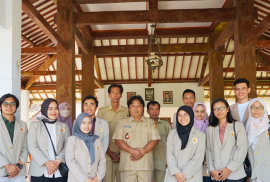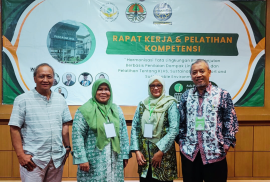
On August 21–23, 2024, representatives from the Master’s and Doctoral Programs in Environmental Science at the UGM Graduate School, Dr. Sudaryatno, M.Si., and Dr. Nurul Khakhim, M.Si., attended the 11th National Working Meeting (Rakernas) of the Association of Environmental Science Study Programs (PEPSILI) in Bali. PEPSILI is a legally recognized network organization that facilitates collaboration among all environmental science study programs across Indonesia, aiming to advance environmental science in accordance with the Tri Dharma of Higher Education, particularly in education, research, and community service.
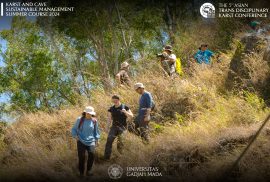
The UGM Environmental Science Summer Course on “Karst and Cave Sustainable Management” was conducted through several activities. On August 15, one of the key highlights was a field trip that allowed participants to directly observe natural phenomena in the karst and cave systems around the Special Region of Yogyakarta. This activity also served as an important platform to introduce participants to the diverse karst ecosystems of Indonesia, which exhibit structural characteristics distinct from the karst formations in the participants’ home countries. Through this field trip, participants were expected to directly identify karst structures in several caves and analyze both the potentials and challenges within these ecosystems.
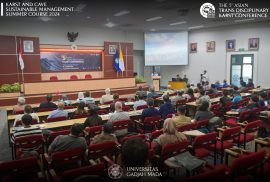
On August 12–14, 2024, the Environmental Science Program at Universitas Gadjah Mada (UGM) conducted the second Summer Course series. The 5th Asian Trans-Disciplinary Karst Conference 2024, an in-person follow-up to the previous online course, was attended by participants from over 15 countries. The event served as a platform for knowledge sharing, experience exchange, and direct international collaboration. The conference spanned three days and included seminars and panel sessions.
(International Conference Documentation)
The event was inaugurated by the Dean of the Graduate School and Prof. Dr. Eko Haryono, M.Si., the Chair of the Organizing Committee. The opening session continued with an introduction to the International Union of Speleology (UIS) by Prof. Nadja Zupan Hajna, followed by a presentation on the upcoming 19th International Congress of Speleology in Brazil, scheduled for July 20–27, 2025, delivered by Jose Ayrton Labegalini, Chair of the Congress Organizing Committee.
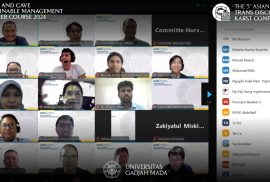
The UGM Environmental Science Summer Course, themed “Karst and Cave Sustainable Management,” was conducted through a series of activities. The first activity in this series was an online course dedicated to exploring speleology in depth, featuring karst and cave experts from around the world. This initiative represents UGM’s effort to facilitate global discussion and knowledge sharing on speleology. The online course ran from July 29 to August 9, 2024.
(Online Course Documentation)
The online course was attended by speakers and participants from over 15 countries, including lecturers, researchers, environmental practitioners, community members, students, and representatives from various institutions. In addition to Indonesian experts, international specialists such as John Gun, Blaz Kogovsek, Terry Bolger, Luiz Edwardo Penisset, Alena Gessert, and David Gillieson shared their expertise. These experts were fully committed to providing participants with comprehensive knowledge. According to the participants, the lectures were detailed, engaging, and easy to understand. Topics covered included karst and cave hydrology, geomorphology, and karst and cave management practices in various countries.
The UGM Environmental Science Program initiated a summer course themed “Karst and Cave Sustainable Management” from July 29 to August 15, 2024. This summer course is part of UGM’s innovative academic and internationalization program aimed at enhancing the university’s visibility in interdisciplinary excellence. Lecturers and participants came from over 15 countries, with backgrounds including academics, researchers, environmental practitioners, community members, students, and institutional representatives. The program focused on speleology—the scientific study of caves, including their formation (speleogenesis), structure, physical characteristics, history, and biological aspects. Its objectives were to advance speleology through global knowledge exchange among practitioners, introduce and promote Indonesia’s unique speleological features, and increase global interest in speleological science.
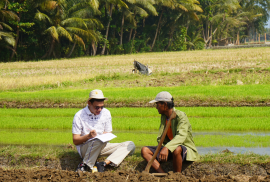
Students of the Master of Environmental Science program conducted a social analysis in the coastal areas of Jatikontal and Gedangan Villages, Purwodadi District, Purworejo Regency, as part of the Field Study Program held on 15–19 July 2024. The Environmental Science Program at UGM recognizes that communities play a crucial role in environmental stewardship. The serious impacts of insufficient public awareness regarding waste management extend beyond environmental degradation to issues of public health and disruptions to marine ecosystems. Therefore, students were assigned to evaluate community perceptions and participation in waste management. They distributed questionnaires containing questions on the characteristics, perceptions, and participation of respondents regarding waste management.
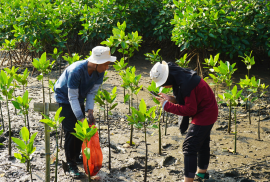
In addition to conducting physical and social analyses, graduate students of the Environmental Science Master’s Program carried out a biotic assessment along the coastal areas of Jatikontal and Gedangan Villages, Purwodadi District, Purworejo Regency, as part of the Field Study (KKL) program held on 15–19 July 2024. Mangrove biodiversity in coastal regions plays a critical role in maintaining biotic ecosystem balance, protecting shorelines from erosion, and mitigating the impacts of natural hazards. For this reason, the students conducted a Mangrove Health Index (IKM) assessment to determine the condition and health status of mangroves in the coastal zones of both villages. Transects were placed using purposive sampling at three points considered to be representative of field conditions. The parameters used in the Mangrove Health Index included tree density, leaf morphometrics, species diversity index, evenness index, and mangrove species count.
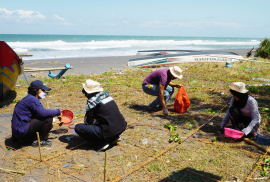
The Environmental Science Master’s Program conducted a physical environmental analysis along the coastal areas of Jatikontal Village and Gedangan Village, Purwodadi Subdistrict, Purworejo Regency, during the Field Study Program held on 15–19 July 2024. Physical factors—particularly waste—play a significant role in influencing the balance of marine ecosystems. Therefore, the Environmental Science Program instructed students to carry out an evaluation of coastal cleanliness by using plastic waste as an indicator and assessing the potential hazards posed by dangerous objects found along both coastal areas. The activities were conducted rigorously and systematically. Students collected waste samples within transects and sub-transects, sorted them, and recorded their findings. In addition to identifying waste types, the analysis also included waste weight, composition, and density.
The Environmental Science Study Program, Graduate School, conducted a Field Study (Kuliah Kerja Lapangan/KKL) in Jatikontal Village and Gedangan Village, Purwodadi Sub-district, Purworejo Regency, from 15–19 July 2024. Purworejo Regency has significant potential for coastal area development, with a coastline stretching 21 kilometers. However, one of the most pressing environmental issues along the coastal area is waste pollution originating from multiple sources. Therefore, the Environmental Science Program engages students through this Field Study to contribute to addressing these challenges. The activity was supervised by Dr. Bachtiar Wahyu Mutaqin, S.Kel., M.Sc., Prof. Dr. Ig. L. Setyawan Purnama, M.Si., and Dr. Rika Harini, S.Si., MP.