
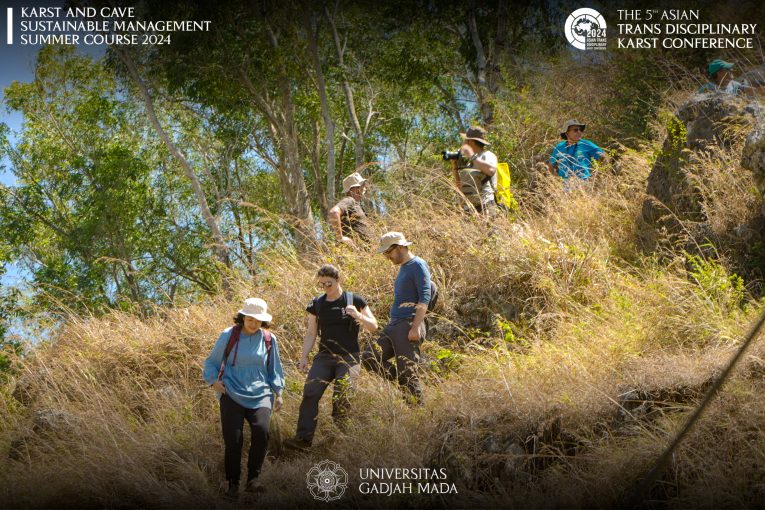
The UGM Environmental Science Summer Course on “Karst and Cave Sustainable Management” was conducted through several activities. On August 15, one of the key highlights was a field trip that allowed participants to directly observe natural phenomena in the karst and cave systems around the Special Region of Yogyakarta. This activity also served as an important platform to introduce participants to the diverse karst ecosystems of Indonesia, which exhibit structural characteristics distinct from the karst formations in the participants’ home countries. Through this field trip, participants were expected to directly identify karst structures in several caves and analyze both the potentials and challenges within these ecosystems.


(Field Trip Documentation)
The field trip lasted a full day. The first destination was the Indonesian Karst Museum, located in Gebangharjo Village, Pracimantoro Subdistrict, Wonogiri, approximately a two-hour bus journey. This was followed by an exploration of Serpoan Cave within the Gunung Sewu karst region in Ponjong Subdistrict, Gunung Kidul Regency. The trip continued to Baron Beach, a coastal area forming a basin surrounded by karst hills, with an underground river flowing rapidly toward the sea, located in Tanjungsari Subdistrict, Gunung Kidul Regency. Each of these karst regions possesses unique ecosystems, providing participants with a broader understanding of the ecological diversity of karst landscapes.


(Field Trip Documentation)
Beyond gaining knowledge, several participants reported having enjoyable experiences not found in their home countries. The differences in ecosystem composition were particularly intriguing, as the biotic components of each karst ecosystem vary significantly. Through their analyses, participants practiced critical thinking skills, enabling them to formulate optimal solutions for the ecological challenges faced in karst regions. In this way, the activity contributed to the achievement of the Sustainable Development Goals (SDGs), specifically Goal 4: Quality Education, and Goal 15: Life on Land. Participants acquired new insights into Indonesia’s karst structures while simultaneously supporting the conservation of karst ecosystems both in Indonesia and in their respective countries through their analytical and critical thinking skills.
Author: Izza A