

Yogyakarta, 11 July 2026 – Following the successful implementation of the Basic Environmental Impact Assessment (EIA/AMDAL) Training Batch 1 in late June 2026, the Master’s and Doctoral Programs in Environmental Science at the Graduate School of Universitas Gadjah Mada (UGM) continued their commitment to strengthening students’ professional competencies by facilitating Basic EIA Training Batch 2 (Batch 206), organized by the UGM Center for Environmental Studies (PSLH UGM). The six-day training program, held from 6 to 11 July 2026, was attended by 24 master’s and doctoral students from the Environmental Science Program through a combination of synchronous and asynchronous online learning. The program represents a tangible collaboration between PSLH UGM and the UGM Graduate School in enhancing human resource capacity in environmental impact assessment and management while expanding students’ access to nationally recognized competency training.
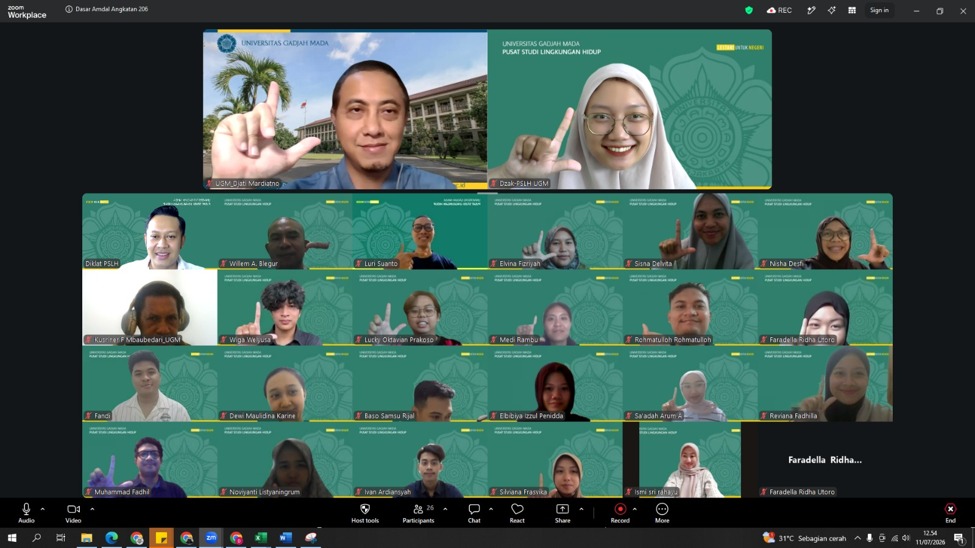

The training was officially opened by Dr. Endang Astuti, M.Si., who emphasized the importance of mastering Indonesia’s Environmental Impact Assessment (EIA) regulatory framework and methodologies for academics and future environmental practitioners. She highlighted the strategic role of environmental assessment documents in Indonesia’s business licensing process and environmental feasibility decision-making. Throughout the six-day program, participants completed 45 instructional hours covering nine training modules, including the fundamentals of Environmental Impact Assessment (AMDAL), Environmental Management and Monitoring Efforts (UKL-UPL), and Environmental Management Statements (SPPL); environmental scoping and identification of hypothetical significant impacts; ecosystem and spatial planning assessments; preparation of the Terms of Reference (KA), Environmental Impact Analysis Report (ANDAL), and Environmental Management and Monitoring Plans (RKL-RPL); as well as professional ethics for EIA preparers and reviewers, the Amdalnet Environmental Document Information System, and environmental feasibility supervision and compliance.
The training was delivered by a distinguished team of lecturers and environmental experts, including Dr. Endang Astuti, M.Si.; Drs. Namastra Probosunu, M.Sc.; Adhi Nilasari, S.Si., M.Kes.; Dr. Eko Sugiharto, DEA; Galih Dwi Wijayanto, S.Si., M.Sc.; Taufik Abdillah Natsir, S.Si., M.Sc., Ph.D.; Dr. Wahyu Yun Santoso, S.H., M.Hum., LL.M.; Dr. Ir. Syampadzi Nurroh, S.Hut., M.Sc., C.EIA., CSP.GIS., IPM.; Ir. Subaryono, M.A., Ph.D.; Dr. Deni Pranowo, M.Si.; and Risvy Valentine Immanuel, S.T., M.T. In addition to theoretical instruction, participants completed a series of practical assignments designed to strengthen their technical skills in preparing environmental assessment documents, including the preparation of the Terms of Reference (KA), Environmental Impact Analysis (ANDAL), and Environmental Management and Monitoring Plans (RKL-RPL). As part of the learning assessment, participants completed a pre-test at the beginning of the program and two comprehensive examinations on the fourth and sixth days to evaluate their understanding of the course materials. Based on the final evaluation, all 24 participants successfully completed the training, achieving a 100% completion rate, demonstrating the program’s effectiveness in equipping graduate students with fundamental Environmental Impact Assessment competencies.
The Basic EIA Training Batch 206 concluded with closing remarks by Prof. Dr. Djati Mardiatno, S.Si., M.Si., who expressed his appreciation for the participants’ enthusiasm and commitment throughout the intensive six-day program. He encouraged participants to apply the knowledge and practical skills they had gained in both academic research and professional environmental management practice. The participation of master’s and doctoral students in this training is expected to strengthen both their academic foundation and practical expertise, enabling them to contribute more effectively to environmental protection and sustainable environmental management.
Contributing to the Sustainable Development Goals (SDGs)
The implementation of the Basic Environmental Impact Assessment (EIA) Training is closely aligned with several United Nations Sustainable Development Goals (SDGs). By enhancing the competencies of graduate students through certified professional training, the program contributes to SDG 4 (Quality Education). Its emphasis on spatial planning and environmentally responsible development supports SDG 11 (Sustainable Cities and Communities) by promoting development that considers environmental carrying capacity, while its focus on managing environmental impacts from development activities advances SDG 12 (Responsible Consumption and Production).
Furthermore, the comprehensive coverage of ecosystem assessment, spatial planning, and environmental impact mitigation supports SDG 13 (Climate Action) and SDG 15 (Life on Land), recognizing Environmental Impact Assessment as a preventive instrument for minimizing environmental degradation and ecosystem damage from the earliest stages of project planning. The inclusion of environmental regulations, institutional frameworks, and professional ethics for EIA preparers and reviewers also contributes to SDG 16 (Peace, Justice and Strong Institutions) by promoting transparent, accountable, and science-based environmental governance. Finally, the cross-sector collaboration between PSLH UGM and the UGM Graduate School exemplifies SDG 17 (Partnerships for the Goals), highlighting the importance of institutional partnerships in advancing sustainable development within higher education.
Author: Lucky Oktavian Prakoso