

TAIWAN – The Graduate School of Universitas Gadjah Mada (UGM), through its Master’s (S2) and Doctoral (S3) Programs in Environmental Science, once again demonstrated its commitment to enhancing students’ academic capacity through participation in an international forum. This was realized through involvement in The 2026 Annual Meeting of the Geography Society, held at National Changhua University of Education from April 23 to 27, 2026. This participation was part of the Student Mobility Program, which aims to broaden global perspectives, strengthen academic competencies, and expand international networks among UGM’s academic community. The delegation consisted of 14 participants, including faculty members, master’s and doctoral students, as well as alumni, all of whom actively contributed as presenters in various scientific sessions.
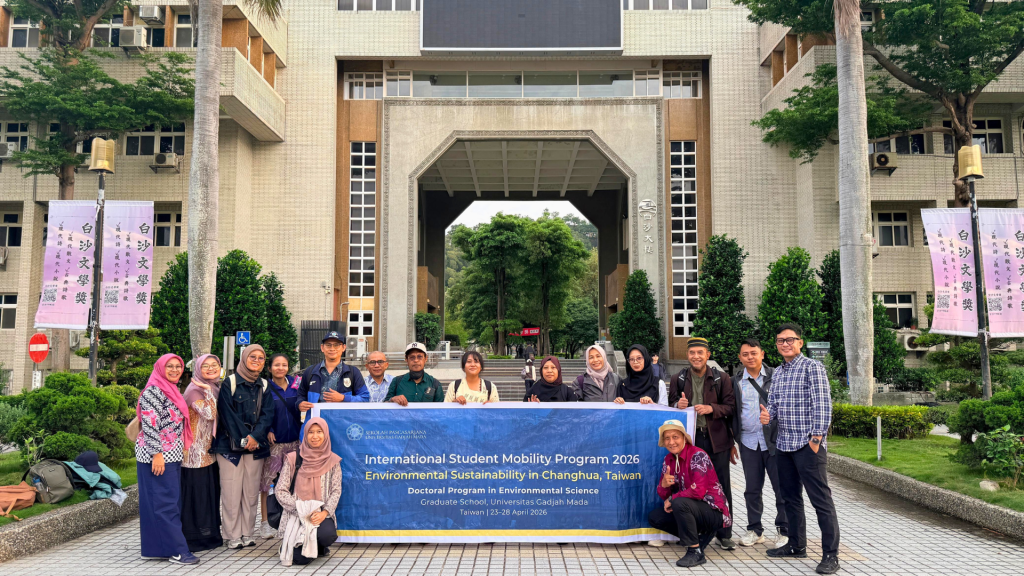
(Student Mobility Program Team)


(Main Session of the 2026 Annual Meeting of the Geography Society )
During the forum, the main session featured a keynote speaker from the University of Wisconsin–Madison, Kris Olds, who discussed the evolving global landscape of higher education and research. The forum was then divided into several panels, including three Joint Panels on “Environmental Sustainability,” which were the result of collaboration between UGM, National Taiwan University (NTU), and National Changhua University of Education (NCUE). Panel 1 was moderated by Prof. Dr. Eko Haryono, Panel 2 by Elok Surya Pratiwi, Ph.D., and Panel 3 by Dr. Sudaryatno.
Across these panels, the UGM team presented a wide range of research addressing strategic environmental issues, including geomorphology and disaster studies, environmental quality and public health, environmental management, and socio-ecological resilience. The topics covered included landslide susceptibility analysis, the use of LiDAR technology for erosion identification, PM2.5 concentration modeling using machine learning approaches, as well as studies on coastal ecosystem sustainability and pro-environmental behavior.
In addition to the UGM team, a teaching assistant from NCUE, Yu-Kai Liao, also presented a study titled “Cultures of Prediction in Atmospheric Science: Climate Services in Vietnam.” Each presenter delivered their work followed by interactive discussions with the audience and fellow conference participants.

 (“Environmental Sustainability” Joint Panel)
The Head of the Doctoral Program in Environmental Science at UGM, Prof. Eko Haryono, stated that participation in international forums serves as a strategic platform to enhance students’ academic capacity, particularly in scientific communication and the development of global perspectives. This view was supported by Dr. Sudaryatno, who emphasized the importance of cross-country academic experiences in strengthening students’ academic and professional competencies.
Beyond academic benefits, this activity also served as an important momentum for exploring international collaborations between UGM and institutions in Taiwan, including opportunities for student exchange, joint research, and the development of future collaborative programs. Active engagement during the conference opened avenues for discussions that may lead to cross-border research collaborations.
Participation in this conference provided significant benefits for students, both in terms of hard skills and soft skills development, including critical thinking, scientific communication, and adaptability in a global environment. This experience is expected to produce graduates who are not only academically excellent but also equipped with a global perspective to address increasingly complex environmental challenges.
This activity also contributes to the achievement of the Sustainable Development Goals (SDGs), particularly SDG 4 (Quality Education), SDG 11 (Sustainable Cities and Communities), SDG 13 (Climate Action), SDG 14 and 15 (Life Below Water and Life on Land), as well as SDG 17 (Partnerships for the Goals).
Through this initiative, UGM continues to affirm its role as a higher education institution that actively contributes to research-based solutions while fostering global collaboration for environmental sustainability.
Author: Student Mobility Program Team