
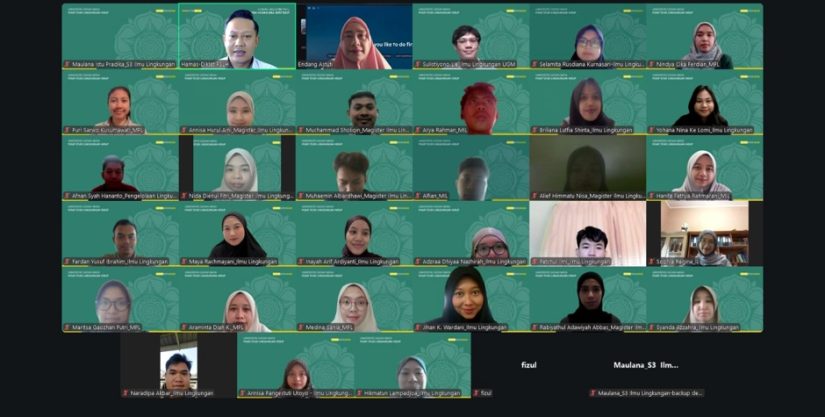
The Environmental Science Program, Graduate School, Universitas Gadjah Mada (UGM), continued its efforts to strengthen students’ competencies in environmental management through the Basic Environmental Impact Assessment (AMDAL) Training Batch 3. The training was organized by the Center for Environmental Studies (PSLH) UGM in collaboration with the UGM Environmental Science Program and attended by 33 postgraduate students of Environmental Science at UGM. Held from 27–31 July 2026, the training was officially opened by Dr. Endang Astuti, M.Si. The program was conducted online, combining synchronous and asynchronous learning through a Learning Management System (LMS).
Over the five-day training, participants received comprehensive instruction on various fundamental aspects of AMDAL, beginning with the basic concepts of AMDAL, UKL-UPL, and SPPL as instruments for environmental protection and management, as well as the AMDAL process in Indonesia and its benefits for the government, project proponents, and communities. These topics provided participants with a foundation for understanding the role of AMDAL in the planning of business and/or development activities.
The training also covered AMDAL screening and its relationship with spatial planning policies, including the Environmental Protection and Management Plan (RPPLH), Strategic Environmental Assessment (KLHS), Detailed Spatial Plan (RDTR), and protected areas. Participants further gained an understanding of the relationship between AMDAL and the business licensing system, basic approvals, sectoral and regional regulations, as well as the integration of technical approvals into AMDAL and UKL-UPL processes.
Ecological aspects constituted an important component of the training. Participants learned about the basic concepts of ecosystems, ecosystem components and networks, as well as key indicators of ecosystem vulnerability as a basis for determining significant impacts. This understanding was subsequently linked to environmental feasibility decision-making.
In the subsequent sessions, participants were introduced to the concept of environmental impacts in AMDAL and the scoping process. The learning covered the identification of impact sources and receptors, as well as primary, secondary, and tertiary impacts, along with the identification of key issues in AMDAL studies. Participants then learned how to determine Hypothetical Significant Impacts (Dampak Penting Hipotetik/DPH) based on the four criteria stipulated in Government Regulation No. 22 of 2021, including the determination of study area boundaries and temporal boundaries.
Beyond conceptual learning, the training provided opportunities for participants to develop practical skills. Participants carried out exercises in determining hypothetical significant impacts, study area boundaries, and temporal boundaries. They also gained practical experience in preparing the Terms of Reference (KA), ANDAL (Environmental Impact Analysis), and RKL-RPL (Environmental Management and Monitoring Plans) for one type of DPH.
The subsequent sessions covered the prediction of the magnitude and significance of environmental impacts and the holistic evaluation of environmental impacts, followed by the preparation of the KA and ANDAL. At this stage, participants were guided to understand how the results of environmental impact assessments are translated into AMDAL documents as part of the decision-making process concerning environmental feasibility.
On the fourth day, participants received materials on AMDAL guidance and supervision, environmental feasibility assessment, the basic principles of environmental management, approaches to managing and monitoring environmental impacts, as well as the ethics of AMDAL preparers and assessors. Participants also learned about changes to environmental approvals, types of business and/or activity changes that may result in amendments to environmental approvals, and the mechanisms for implementing such changes.
The training series concluded with an introduction to the Amdalnet Environmental Document Information System and materials on the Environmental Feasibility Assessment Team (Tim Uji Kelayakan Lingkungan Hidup). Participants also completed practical assignments and a comprehensive examination as part of the learning evaluation throughout the training.
Through the Basic AMDAL Training Batch 3, postgraduate students of Environmental Science at UGM are expected to develop a more comprehensive understanding of the AMDAL process while gaining practical skills that can support their academic and professional activities in the field of environmental protection and management.
The training represents the commitment of the UGM Environmental Science Program and PSLH UGM to strengthening human resource capacity in support of sustainable development. The Basic AMDAL Training Batch 3 aligns with SDG 4 (Quality Education) by enhancing students’ competencies in environmental fields, while also supporting SDG 11 (Sustainable Cities and Communities) and SDG 12 (Responsible Consumption and Production) through an understanding of spatial planning and environmental impact management in development activities. The materials on ecosystems and impact evaluation further contribute to SDG 13 (Climate Action) and SDG 15 (Life on Land), while learning related to regulations, supervision, environmental feasibility assessment, and AMDAL ethics supports SDG 16 (Peace, Justice and Strong Institutions). Meanwhile, the collaboration between PSLH UGM and the UGM Environmental Science Program reflects the spirit of SDG 17 (Partnerships for the Goals) through joint efforts to strengthen capacity building and environmental education.
Author: Selamita R