
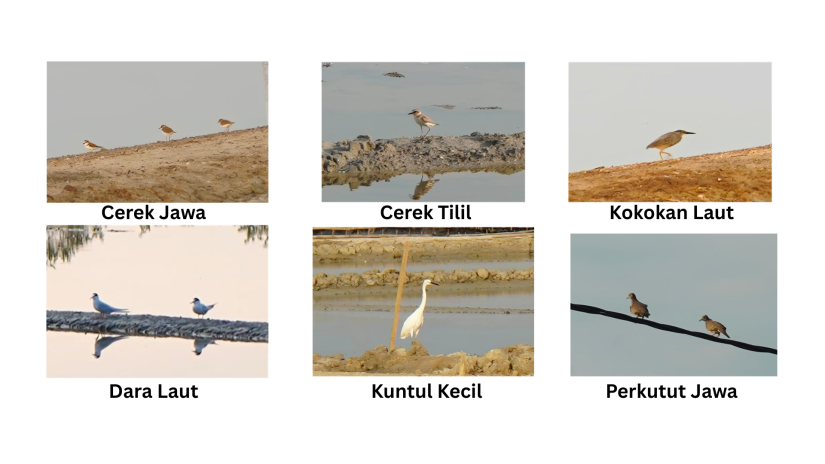
REMBANG, June 26, 2026 – Birds (avifauna) are widely recognized as sensitive biological indicators of ecosystem stability and environmental quality. To assess the ecological health of coastal ecosystems along the northern coast of Java, students from the Master’s Program in Environmental Science at Universitas Gadjah Mada (UGM) conducted a comprehensive survey of avifaunal diversity in Pasar Banggi Village, Rembang Regency, Central Java. The field research formed part of the 2026 Thematic Field Study (Kuliah Kerja Lapangan/KKL), held from June 22–25, 2026, under the supervision of Dr. Priyaji Agung Pambudi, S.Pd., M.Si. The biotic research team specializing in avifauna consisted of Jihan Kamila Wardani, Az Zahra Kania, Alief Himmatu Nisa, and Annisa Hurul Aini, who investigated bird diversity across multiple coastal habitat types to better understand ecosystem condition and inform conservation management.

The study was systematically designed to contribute to the achievement of the Sustainable Development Goals (SDGs). It directly supports SDG 14 (Life Below Water) by documenting waterbird and intertidal bird species and evaluating the ecological condition of coastal and mangrove ecosystems that provide essential feeding grounds for wildlife. The research also contributes to SDG 15 (Life on Land) by generating scientific baseline data on biodiversity across coastal habitat mosaics, identifying the conservation status of threatened species, and assessing ecological vulnerability associated with habitat homogenization to support sustainable wildlife conservation strategies.
Field observations were conducted at four sampling stations representing distinct habitat types: a Residential Area Station, reflecting densely populated human settlements; a Fishpond Station, representing commercial open-water aquaculture areas; a Mangrove Forest Station, characterized by dense vegetation; and a Coastal Beach Station, located directly adjacent to the open sea. This habitat-based approach enabled the research team to compare bird communities across different ecological settings within the coastal landscape.
Across the four observation stations, the researchers identified at least 28 bird species belonging to a wide range of taxonomic families. Among all recorded species, the Little Egret (Egretta garzetta) was the most abundant, with 42 individuals observed in the fishpond area and 42 individuals in the mangrove forest. The high abundance of this species indicates the availability of abundant food resources, particularly small fish and crustaceans. However, such dominance may also reflect ecological vulnerability associated with habitat homogenization, where a limited number of species become disproportionately abundant.
Based on the conservation status established by the International Union for Conservation of Nature (IUCN), most recorded species were classified as Least Concern (LC). Nevertheless, the survey documented one Near Threatened (NT) species, the Javan Plover (Charadrius javanicus), and one Endangered (EN) stork species. Several species, including the Blue-eared Kingfisher (Alcedo meninting), the Linchi Swiftlet (Collocalia linchi), and the Javan Plover, are also recognized as species endemic to Indonesia, while the remaining recorded species have broader geographic distributions.

Preliminary findings indicate that the coastal ecosystem of Rembang Regency supports a high degree of habitat heterogeneity, as reflected by the presence of at least 28 bird species distributed across residential areas, fishponds, mangrove forests, and coastal beaches. Ecological assessment classified ecosystem quality as “Good” at the residential, fishpond, and mangrove stations, while the coastal beach station achieved a “Very Good” ecosystem quality rating.
The study also demonstrates that the coastal habitat mosaic functions as an interconnected ecological system. Residential areas provide spaces where wildlife adapts to human activities, fishponds and coastal beaches serve as important feeding grounds, and mangrove forests function as critical shelter and habitat for numerous bird species. However, the pronounced dominance of the Little Egret in fishpond and mangrove habitats suggests a degree of ecological vulnerability arising from habitat homogenization. Such conditions may reduce the long-term resilience of the coastal ecosystem if large-scale land-use changes or environmental degradation occur in the future.
The findings are expected to provide valuable scientific evidence for local governments, conservation agencies, and ecotourism managers in developing evidence-based strategies to protect coastal biodiversity and strengthen sustainable conservation management in Rembang Regency.
Author: Shinta P