In commemoration of Environmental Day 2026, which carries the theme “Inspired by Nature, For Climate, For Future,” the Master’s Program in Environmental Science, Graduate School, conducted an environmental conservation activity entitled “Eco-Action, Climate Reaction: From Land to Water, We Act Together” on Wednesday, May 20, 2026, in the Bompon Watershed (DAS Bompon), Kalisari Hamlet, Kalisari District, Magelang Regency, Central Java. This area has also received the highest recognition from Indonesia’s Ministry of Environment and Forestry (KLHK) as a ProKlim Lestari village due to its excellence in water resource preservation and its ongoing tree-planting efforts around water springs.
SDG 8
Yogyakarta, March 4, 2026 – Continuing the preparation for the 2026 Fieldwork Program (KKL), the Master of Environmental Science Study Program held its first technical briefing class on Wednesday, March 4, 2026, in Room 406, Graduate School, Gadjah Mada University. The class was attended by 42 KKL students and focused on developing the topics of Mangrove Vegetation Structure and Avifauna (bird) Diversity. This briefing session was led by Dr. Priyaji Agung Pambudi, S.Pd., M.Si. In his presentation, Dr. Priyaji provided comprehensive technical guidance on field data collection methods, particularly regarding accessibility and mapping of observation zones in the coastal areas of Pati Regency.
Yogyakarta, October 20, 2025 — Energy is one of the vital needs in national development and the utilization of the country’s natural resources. Historically, energy demand has relied on fossil fuels, which requires a gradual transformation toward New and Renewable Energy (NRE). This transformation can begin with aspects of knowledge, human resources for management and development, as well as the availability of adequate infrastructure. Fossil fuel-based energy has contributed to global climate change and tends to cause global warming. An important aspect that must not be overlooked is that the development of NRE is strongly influenced by, and impacts, the social aspects of communities around NRE implementation sites.
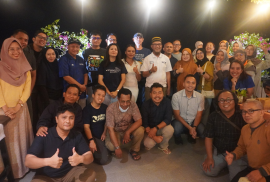
The Doctoral Program in Environmental Science, Graduate School of Universitas Gadjah Mada (UGM), organized an activity under the Lesser Sunda Expedition in collaboration with the Doctoral Program in Population Studies and the Doctoral Program in Geography. The target location of this expedition was the premium tourism area of Labuan Bajo. As part of the series of activities, an Interactive Talkshow was held between UGM representatives, partners, and alumni. The event, conducted on 3 July 2025, was attended by Prof. Eko Haryono and Dr. Sudaryatno along with the expedition participants, Dr. Leonard Chrysostomos Epafras (representing Public Relations and Collaboration of UGM Graduate School), representatives from Keluarga Alumni Gadjah Mada (KAGAMA) Manggarai Chapter led by Mr. Stefan, partners from Komodo National Park (TNK) represented by Mr. Ichwan, and academics from El Bajo Campus in Labuan Bajo.
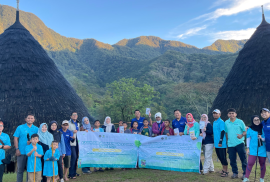
A total of 25 doctoral students from Universitas Gadjah Mada representing three study programs—Environmental Science, Geography, and Population Studies—conducted the Sunda Kecil Expedition, one of which took place in Wae Rebo Village, Manggarai Regency, East Nusa Tenggara Province, on July 2–3, 2025. This activity formed part of a field-based learning initiative designed to connect students with real-world practices of culturally and environmentally grounded village tourism management.
(Documentation of the Activity)
Wae Rebo is renowned as a traditional village located in a mountainous area that can only be reached after a three- to four-hour hike. The village’s main attraction lies in its seven conical traditional Manggarai houses known as Mbaru Niang, which encircle a sacred stone altar called Compang.
East Nusa Tenggara, July 2025 – Twenty-five doctoral students from Universitas Gadjah Mada (UGM), representing the Doctoral Programs in Environmental Science, Geography, and Population Studies, conducted the Sunda Kecil Expedition from July 1–7, 2025. This initiative served as a transdisciplinary learning platform connecting science, culture, and sustainability policy. Four strategic locations were chosen as the focus of the expedition, each illustrating the complex relationship between humans and the environment in the eastern Indonesian archipelago.