

Yogyakarta (06/04) — Students conducted a field study as part of the Environmental Management course along the banks of the Code River in Yogyakarta, accompanied by Prof. Bakti Setiawan. The activity was designed as a contextual learning experience to understand directly how environmental management principles are implemented amid limited space and high urban population density.

(Explanation by Prof. Bakti Setiawan)
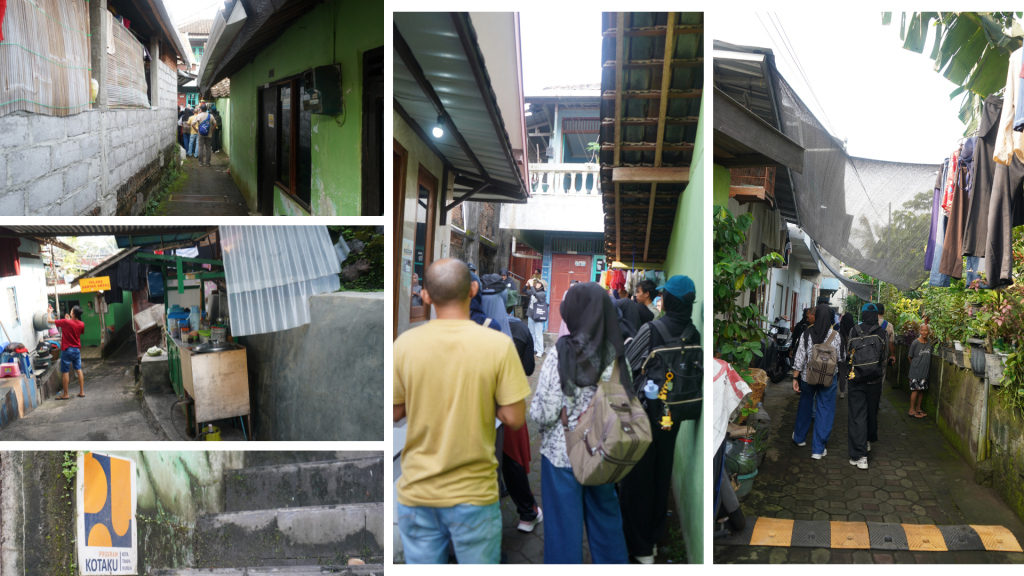
(Residential Area View)
In his introduction, Prof. Bakti explained that environmental management does not only concern the technical aspects of management but also encompasses social, economic, and spatial dimensions. One of the main issues observed was population and building density, reflected in the high ratio of building area to land area. This condition indicates significant pressure on the environmental carrying capacity, particularly in riverbank areas. In the case of the Code River, settlement patterns have developed organically, largely through the informal sector. “Here we can see how communities adapt to limited land availability, often without prior structured planning,” he explained.
Although some areas visually appear less organized, location remains a major attraction. Proximity to urban activity centers and the position within a waterfront area along the riverbank make the area desirable for residents. This illustrates that in urban environmental management, accessibility is often a primary consideration for communities, sometimes outweighing physical comfort factors.
In the context of environmental planning, Prof. Bakti emphasized the importance of locally adaptive approaches, one of which is the 3M principle: Mundur, Munggah, Madhep Kali. He explained that mundur means providing a safe setback distance between buildings and the river; munggah refers to elevating buildings to reduce flood risk; and madhep kali means orienting houses toward the river so that residents become more aware of and responsible for the surrounding environmental conditions. This principle represents how environmental management practices can emerge from contextual local wisdom.

(Sanitation Facilities)
Beyond physical aspects, the study also highlighted the importance of social capital in supporting successful environmental management. Strong relationships among residents (social bonding), the ability to build broader networks (bridging), and connections with formal institutions (linking social capital) form the foundation for providing basic services. This can be seen in shared facilities such as public toilets, communal wastewater treatment systems (IPAL), and initiatives to provide safe drinking water through a “drinking water bank.” From an environmental management perspective, this demonstrates that successful management depends not only on infrastructure but also on community participation and collective action.
Nevertheless, challenges remain. The development of the informal sector, which often occurs without formal planning, can create legal issues, particularly when buildings stand on unofficial land while still utilizing public utilities such as electricity and clean water. In contrast, the formal sector tends to be more structured because it is usually preceded by infrastructure development. This distinction represents an important issue in achieving equitable urban environmental management.

(Tourism Village and Urban Green Space)
Another significant issue is the limited availability of green open space (Ruang Terbuka Hijau/RTH), which ideally should reach 30% of the total urban area. In densely populated riverbank areas, fulfilling this target becomes challenging, requiring community-based innovations. One example is the “river school” initiative, which functions not only as an educational space but also as a participatory approach to water resource management.
Through this field study, students were encouraged to understand that environmental management is not merely a normative concept but a practical reality shaped by social, economic, and urban spatial dynamics. Direct observation in the Code River riverbank area provides insight that sustainable environmental management requires collaboration among communities, academics, and government, as well as adaptive approaches that respond to local conditions.
This learning activity is also aligned with the Sustainable Development Goals (SDGs), particularly SDG 6 (Clean Water and Sanitation) through community-based water and sanitation management efforts, SDG 11 (Sustainable Cities and Communities) in the context of more sustainable urban settlement planning, and SDG 13 (Climate Action) through increased community awareness of environmental management and disaster risk mitigation, such as flood risks in riverbank areas.
Author: Students of the Environmental Management Course
Editor: Ulyn Nuha