

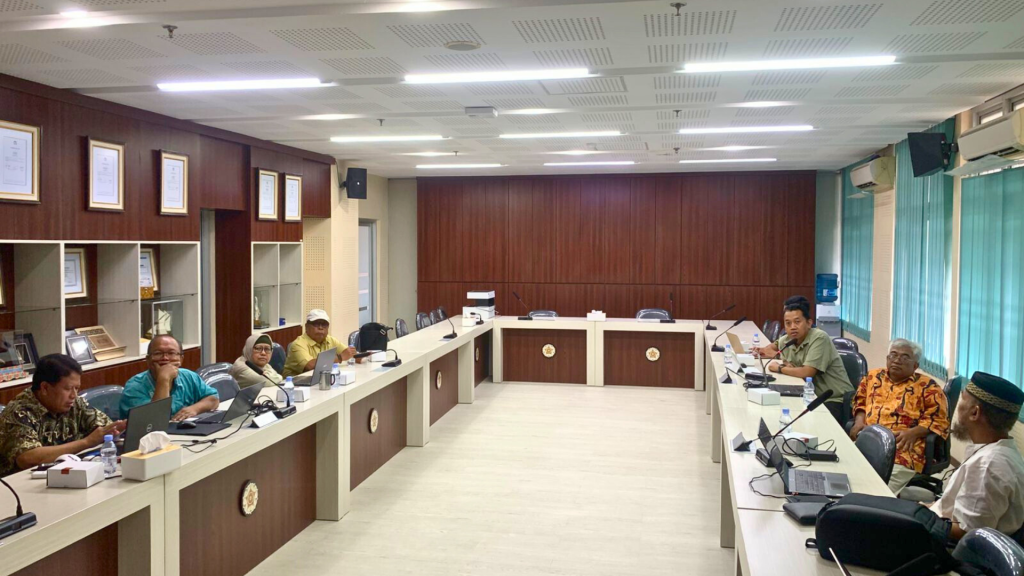
Yogyakarta, 13 February 2026 — The Master’s and Doctoral Programs in Environmental Science at Universitas Gadjah Mada (UGM) convened a Curriculum Consolidation Meeting for the 2026 New Curriculum at Room E503, KLMB Building, Faculty of Geography UGM. The meeting was attended by the Program Management Board, homebase lecturers of the Master’s and Doctoral Programs in Environmental Science, as well as an interdisciplinary Academic Development Team from various faculties. This initiative serves as a preparatory step for revising the Graduate School Curriculum in response to the latest national policy developments.
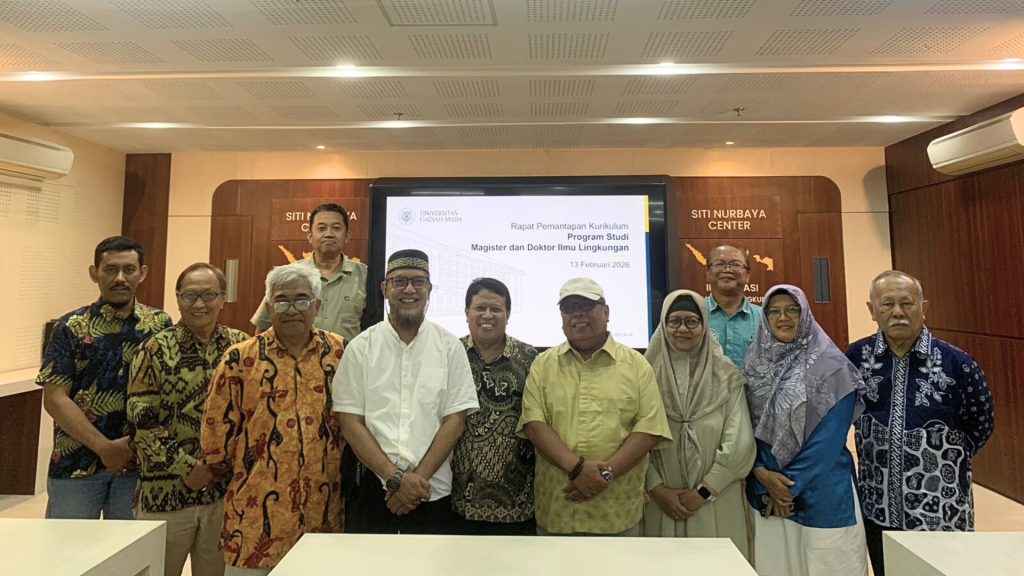
(Activity Documentation)
The Ministry of Education, Culture, Research, and Technology of the Republic of Indonesia has issued Regulation of the Minister of Higher Education, Science, and Technology (Permendiktisaintek) No. 39 of 2025 on Higher Education Quality Assurance, introducing updated regulations concerning higher education curricula in Indonesia. These changes bring significant adjustments, particularly in the calculation of study workload (credit units/SKS), program duration, final project components, and graduate quality standards. In addition, the curriculum revision takes into account the conversion of study workload into the international standard of the European Credit Transfer and Accumulation System (ECTS) to support global recognition and strengthen international accreditation.
The meeting functioned as a strategic forum to align curriculum reform with the dynamic development of scientific knowledge, stakeholder needs, and global environmental challenges. The outcomes include the refinement of study workload calculations (SKS) in accordance with national and international standards, the restructuring of the study timeline, and adjustments to Course Learning Outcomes (CPMK).

(Activity Documentation)
During the meeting, the Head of the Doctoral Program in Environmental Science, Eko Haryono, highlighted the fundamental distinctions between the by course and by research program schemes. These differences encompass student input characteristics and academic backgrounds, curriculum design and structure, graduation requirements, and overall program learning outcomes. He emphasized that the renewed curriculum concept and design aim to provide a more appropriate academic service framework and proportional academic recognition tailored to the characteristics and needs of students in each program track.
Meanwhile, the Head of the Master’s Program in Environmental Science, Sudaryatno, underscored that the curriculum consolidation represents an ongoing commitment to enhancing educational quality and strengthening graduates’ competencies to become adaptive, transdisciplinary, and globally competitive. The updated curriculum also ensures that the learning process remains responsive to strategic issues and the evolving dynamics of environmental science at both national and international levels.
This initiative also contributes to the achievement of the Sustainable Development Goals (SDGs), particularly SDG 4 (Quality Education), SDG 13 (Climate Action), SDG 15 (Life on Land), and SDG 17 (Partnerships for the Goals). Through strengthening a quality-driven and internationally aligned curriculum, the Master’s and Doctoral Programs in Environmental Science at UGM’s Graduate School reaffirm their commitment to producing competent and ethical human resources who contribute to sustainable development at national and global levels.
Author: Ulyn Nuha